
The 10000mAh phone India buyers kept asking about is finally here: vivo’s S2 FE goes on sale tomorrow, and suddenly every phone conversation is about one number. Five thousand was “big” a couple of years ago. Now 6,500, 8,000 and 10,000mAh phones are all sitting in the same festive shopping window. So the real question is not “is 10,000 impressive” (it is) but “should your money go into battery cells or into something else?”
We skipped the launch-day spec dump. Instead we ran four battery-first phones through some simple napkin maths: rupees per 1,000mAh, grams per 1,000mAh and charging speed. Then we built a 4-question Battery Size Decider so you can pick a size before the Diwali sale noise gets louder. Spoiler: the biggest battery is not the best battery deal.
Table of Contents
The four phones in our battery maths
We picked phones that are on sale or about to go on sale in India right now, from a basic 5,000mAh to the new 10,000mAh. Prices are launch MRPs from the brands, before bank offers, because bank offers change every week.
- vivo S2 FE: 10,000mAh typical (9,800mAh rated), 44W charging, MediaTek Dimensity 7300e, 224g, Rs 38,999 for 6GB + 128GB. Sale starts 20 October.
- OnePlus Nord CE6: 8,000mAh, 80W SUPERVOOC charging, Snapdragon 7s Gen 4, 215g, launched at Rs 29,999 for 8GB + 128GB in May.
- Tecno Spark 50s 5G: 6,500mAh, 45W charging with the charger in the box, MediaTek Dimensity 6400, Rs 19,990 for 6GB + 128GB. Retail rollout starts 21 October.
- Samsung Galaxy F70 5G: 5,000mAh, 25W charging with the charger sold separately, Exynos 1330, Rs 19,999 for 4GB + 128GB. Sale starts 20 October.
Maths check 1: rupees per 1,000mAh
Divide the launch price by the battery size and you get a rough “battery price tag”. It is a silly metric on its own, because you are also paying for the chip, screen and camera. But it is a great way to see who is charging you a premium for big cells.
- Tecno Spark 50s: about Rs 3,075 per 1,000mAh
- OnePlus Nord CE6: about Rs 3,750 per 1,000mAh
- vivo S2 FE: about Rs 3,900 per 1,000mAh
- Samsung Galaxy F70: about Rs 4,000 per 1,000mAh, before you buy a charger
Now the more useful number. The S2 FE costs Rs 9,000 more than the Nord CE6’s launch price and gives you 2,000mAh more. That works out to roughly Rs 4,500 for every extra 1,000mAh. You also give up charging speed (44W against 80W), reverse charging muscle (6W against 27W) and, on paper, the newer chip. So the 10,000mAh crown comes with a proper premium, not a free bonus.
Maths check 2: weight, the part nobody puts on the box
Here is where vivo genuinely earns some respect. The S2 FE weighs 224g and the Nord CE6 weighs 215g. That is 25 percent more battery for just 9g more phone, roughly 22g per 1,000mAh against about 27g per 1,000mAh. Both are 8.5mm-ish thick. A few years ago, 10,000mAh meant a brick. Now it means a slightly heavier-than-normal phone, and that is real progress in battery tech.
Still, 224g is heavy. If you use your phone one-handed on a crowded Mumbai local or lie in bed holding it above your face, you will notice. Try one in a store before you commit.
Maths check 3: charging time, the hidden trade-off
Bigger battery plus slower charger equals longer wall time. Some quick napkin maths, assuming the usual phone battery voltage of about 3.87V:
- 10,000mAh at 44W: roughly 38.7Wh of energy, so the absolute theoretical floor is about 53 minutes
- 8,000mAh at 80W: roughly 31Wh, so the floor is about 23 minutes
Real charging is always slower than this floor, because phones slow down as they fill up and as they heat up. Treat these numbers as a direction, not a lab test. The direction is clear though: the 10,000mAh phone will need a much longer top-up. If your life involves quick 20-minute charges between meetings or shifts, a smaller battery with a faster charger can actually feel better day to day.
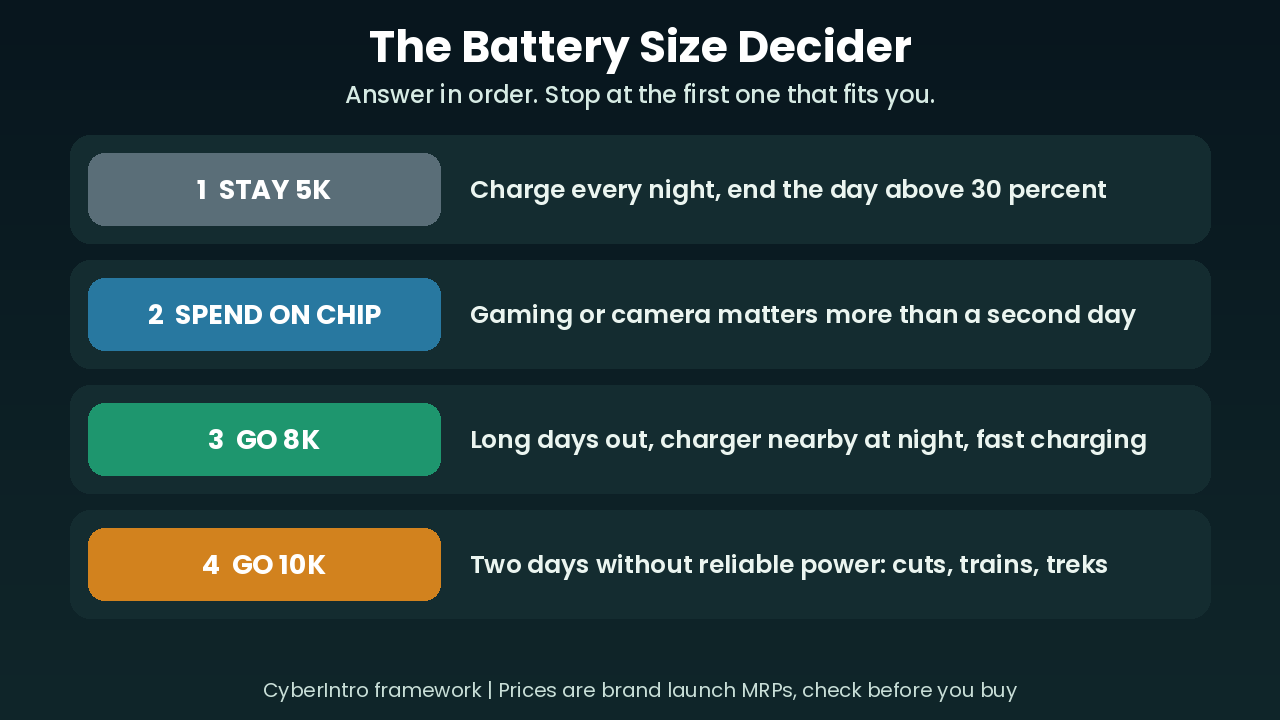
The CyberIntro Battery Size Decider
Answer these four questions in order and stop at the first one that fits you. It takes about a minute, and it can save you several thousand rupees.
1. Do you charge every night and end the day above 30 percent? STAY 5K
If your current 5,000mAh phone already survives a full day, a bigger battery only gives you more unused charge. Spend the money on a better camera, more storage or longer software support instead. This is the majority of office-goers and students who charge by the bed.
2. Is the chip or camera more important than a second day? SPEND ON CHIP
Gamers who care about frame rates and people who shoot a lot of video should prioritise the processor and camera first, then pick the biggest battery within that shortlist. Do not let a battery number pull you into a weaker phone for the things you actually do.
3. Long days away from a socket, but a charger nearby at night? GO 8K
Delivery riders, field sales teams, cab drivers and heavy navigation users fall here. A 7,000 to 8,000mAh phone with fast charging is the sweet spot: enough for a brutal day, and quick to refill when you finally plug in.
4. Two days without reliable power? GO 10K
Frequent power cuts, long train journeys, treks, weddings in the village, or a parent who forgets to charge for days. This is where 10,000mAh makes real sense, and where slower charging matters less because you are charging less often. vivo’s own battery-life claim assumes one full charge every 1.83 days, which tells you exactly who this phone is built for.
Battery health: the 7-year claim, decoded
vivo says the S2 FE’s battery keeps at least 80 percent capacity after 1,400 full cycles in its lab, and at one cycle every 1.83 days it calls that about seven years. OnePlus says its battery tech is designed to last up to six years of daily use on the Nord CE6. Both are company lab claims, so take them as a ceiling, not a promise. One genuine plus of a huge battery: fewer full cycles per month, which in principle means slower wear than a small battery you drain and refill every single day.
Three checks before you add a battery phone to cart
- Is the charger in the box? Tecno includes one with the Spark 50s. Samsung sells the F70’s charger separately. A missing charger quietly raises your real price, so add it to your comparison sheet.
- Typical versus rated capacity: brands advertise the typical number. vivo’s fine print says 9,800mAh rated for the S2 FE. That small gap is normal, but compare like with like.
- The final checkout price: bank discounts, exchange bonuses and EMI fees change the maths. Our festive effective price guide and no cost EMI hidden charges explainer show how to find the real number. And if your current phone is going in exchange, read our exchange offer playbook first.
Also keep an eye on mid-sale price changes. Listings can move during the Diwali run-up, as we explained in our mid sale phone price hike piece, so screenshot the price you are comparing against.
Final Thought
The 10,000mAh phone is a genuine engineering win, and the S2 FE packs it into a body that is barely heavier than an 8,000mAh rival. But on our maths, you pay roughly Rs 4,500 for every extra 1,000mAh over the Nord CE6, along with slower charging. Buy the giant battery if your life has long stretches without a socket. If you charge every night, battery size is a nice-to-have, not a reason to pay more. Run the four-question decider, pick your size, and then hunt the best price for that size. Simple maths, no battery anxiety, full paisa vasool.