
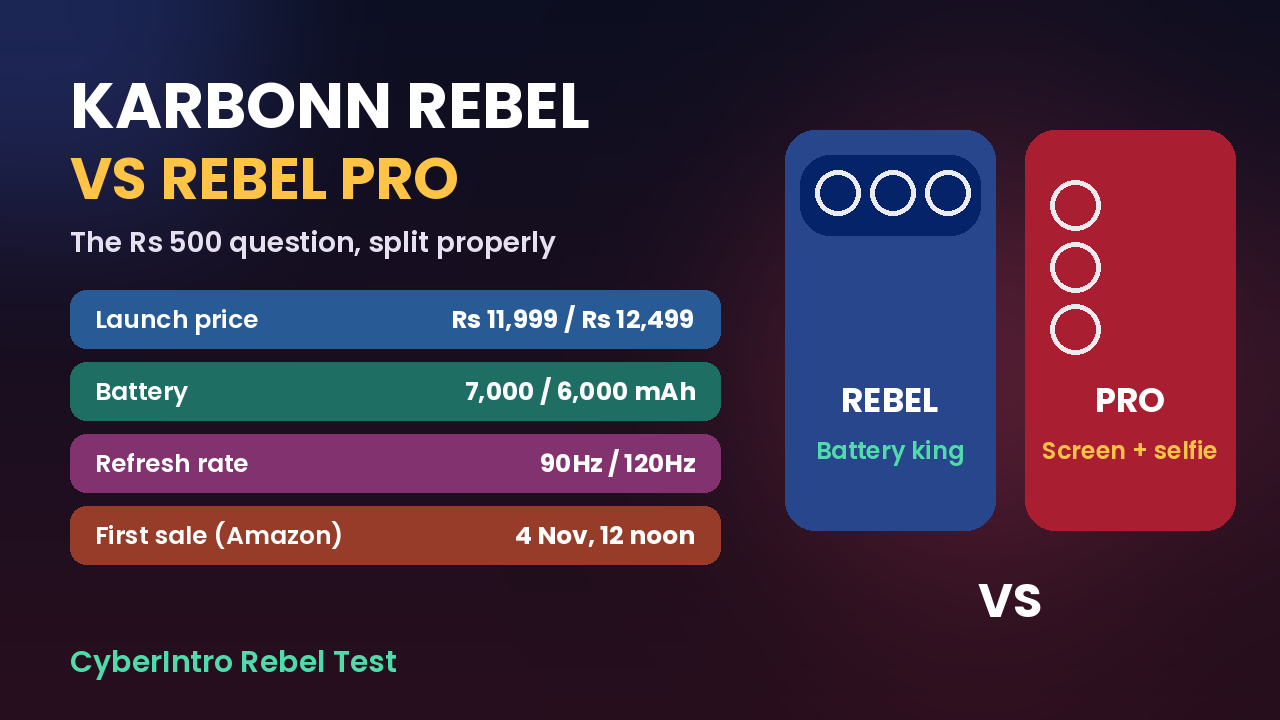
Remember Karbonn? The brand that sat next to Micromax and Lava on every mobile shop counter in the early 2010s? It is back, and it has not come back quietly. On 2 November the company launched two 4G phones, and the obvious question for anyone shopping on a tight budget is Karbonn Rebel vs Rebel Pro: which one deserves your money, and should you buy either at all? The two are separated by just Rs 500, which sounds like a no-brainer until you notice the cheaper one has the bigger battery. So let us split that Rs 500 properly before the first sale opens.
Table of Contents
Karbonn Rebel vs Rebel Pro: price and sale date
Both phones carry an MRP of Rs 14,999, but nobody is expected to pay that. Here are the launch numbers:
- Karbonn Rebel: Rs 11,999 launch price, Rs 10,999 effective with the Rs 1,000 bank offer.
- Karbonn Rebel Pro: Rs 12,499 launch price, Rs 11,499 effective with the same bank offer.
- First sale: 4 November, 12 noon, on Amazon. Both are being sold as Amazon Specials.
- Also coming: a Karbonn Rebel 5G, with specs, price and date still not announced.
One honest warning: launch reports do not agree on memory. GSMArena lists 4GB RAM with 128GB storage on both launch prices, one report says 6GB, and another mentions two variants each. So treat RAM as “check the Amazon listing on sale day” rather than gospel. Storage is expandable up to 1TB via microSD either way, as per reports.
What both phones share
Strip away the colours and most of the hardware is identical:
- MediaTek Helio G81 chipset, octa-core, up to 2.0GHz
- HD+ LCD screen, IP64 dust and splash resistance
- Android 16 with a zero-bloatware promise and no preloaded third-party apps
- Two years of OS updates and two years of security patches
- 3.5mm headphone jack, USB Type-C, side fingerprint scanner, charger in the box
- 4G only, no 5G
The no-bloatware promise deserves a small clap. In a segment where some phones arrive with a folder full of games you never asked for, a clean Android 16 is a real selling point. Two years of updates, though, is the bare minimum, not a flex. Plan on this phone being an “it works, no drama” device, not a five-year companion.
The Rs 500 split: what the Pro adds and what it takes away
Here is where the two actually differ, as per the launch specs:
- Refresh rate: Rebel 90Hz, Rebel Pro 120Hz
- Peak brightness: Rebel 650 nits, Rebel Pro 720 nits
- Main camera: Rebel 50MP f/1.8, Rebel Pro 64MP f/1.8
- Selfie camera: Rebel Pro gets a confirmed 16MP sensor; Karbonn has not detailed the Rebel’s front camera
- Battery: Rebel 7,000mAh, Rebel Pro 6,000mAh
- Charging: Rebel 18W, Rebel Pro 20W
- Screen size: Rebel 6.75-inch, Rebel Pro 6.7-inch
So the Pro is the “looks and feels nicer” phone, and the standard Rebel is the “lasts longer” phone. A quick bit of paper maths makes the trade clearer. Divide battery capacity by charger wattage and you get a rough feel for how much tank each watt has to fill: about 389 for the Rebel against 300 for the Pro. That is not a charge time, and real charging curves are messier, but it tells you the Rebel will spend noticeably longer on the plug, and also last longer off it. Bada tank, slow pump.
One thing to keep in mind: both phones show three rings on the back, but Karbonn has only confirmed one main camera on each. Do not buy either thinking you are getting a triple-camera setup. You are paying for one sensor and some very confident industrial design.
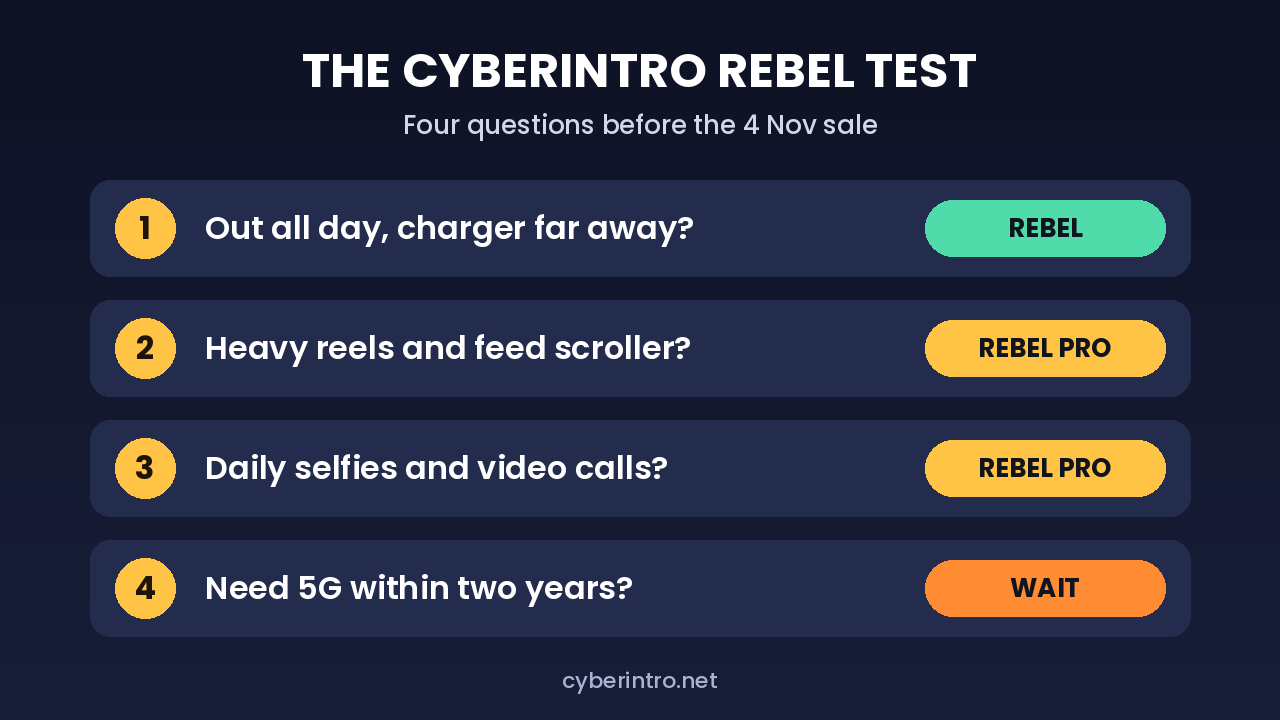
The CyberIntro Rebel Test
Four questions. Answer them like you are explaining your choice to your most sceptical cousin.
1. Do you charge once a day or whenever you remember?
If your phone lives on the charger overnight, the extra 1,000mAh on the standard Rebel matters less. If you are a student, delivery partner, or anyone who leaves home at 8am and returns at 10pm, the 7,000mAh Rebel is the safer bet. Battery anxiety? Pick Rebel.
2. Do you scroll more than you talk?
Reels, feeds, and long chats are where 120Hz feels smoother. The higher 720-nit brightness also helps outdoors. If the screen is your main entertainment, those Rs 500 buy you the nicer daily experience. Heavy scroller? Pick Rebel Pro.
3. Does the front camera matter to you?
Video calls with family, college ID selfies, Instagram stories: if any of these are daily, the Pro has the only confirmed spec here, a 16MP selfie camera. Karbonn has been quiet about the Rebel’s front sensor, and silence on a spec sheet is rarely good news. Selfie person? Pick Rebel Pro.
4. Will you want 5G within two years?
This is the big one. Both phones are 4G only, and the update promise also ends at two years. If you live in a city with good 5G coverage and want those speeds, wait for the Rebel 5G price, or look at a 5G phone in this budget. If 4G is genuinely enough for you, carry on. Want 5G? Wait.
Score it simply. Mostly Rebel answers: buy the Rebel. Mostly Pro answers: spend the extra Rs 500. If question 4 was a firm yes, neither is your phone yet.
The hidden recharge angle of a 4G phone
Here is a small twist nobody puts on the box. On Jio, unlimited 5G is tied to plans with 2GB a day and above, starting at Rs 349 for 28 days. The Rs 299 plan gives 1.5GB a day for 28 days without the unlimited 5G benefit. With a 4G-only phone, unlimited 5G is useless to you, so the cheaper plan is the logical pick, saving Rs 50 every cycle. On Airtel, reports say mainstream daily-data plans now start at Rs 349 after the Rs 299 pack was dropped, so this trick works better on Jio. Plans vary by circle, so check your app before you recharge. We did deeper plan maths in our annual recharge plan guide.
Why the timing actually works in Karbonn’s favour
Karbonn picked an interesting moment. Counterpoint Research says phones under Rs 10,000 in India got around 32% costlier on average in the first half of 2026, thanks to memory chip prices. Lava has said its phones will cost up to Rs 3,000 more from 15 November, and Ai+ hikes kick in the same day. A brand-new 6,000mAh to 7,000mAh phone at an effective Rs 10,999 to Rs 11,499 looks sharper against that backdrop than it would have a year ago. If you are still weighing whether to buy now or hold off, our Dhanteras buy-or-wait test covers the bigger timing picture.
The flip side: a comeback brand has no recent service track record. Before you buy, check the service centre situation in your city and keep the invoice safe. A great spec sheet is half the deal; after-sales is the other half.
Final Thought
Karbonn Rebel vs Rebel Pro is really battery vs everything else. If you want a phone that refuses to die before you do, the Rs 11,999 Rebel is the value ki dukan pick. If you care about a smoother screen and a proper selfie camera, the Pro’s extra Rs 500 is money well spent. And if 5G is non-negotiable, hold your wallet until the Rebel 5G shows its price. Welcome back, Karbonn. Now let us see if the after-sales service has also had a glow-up.