
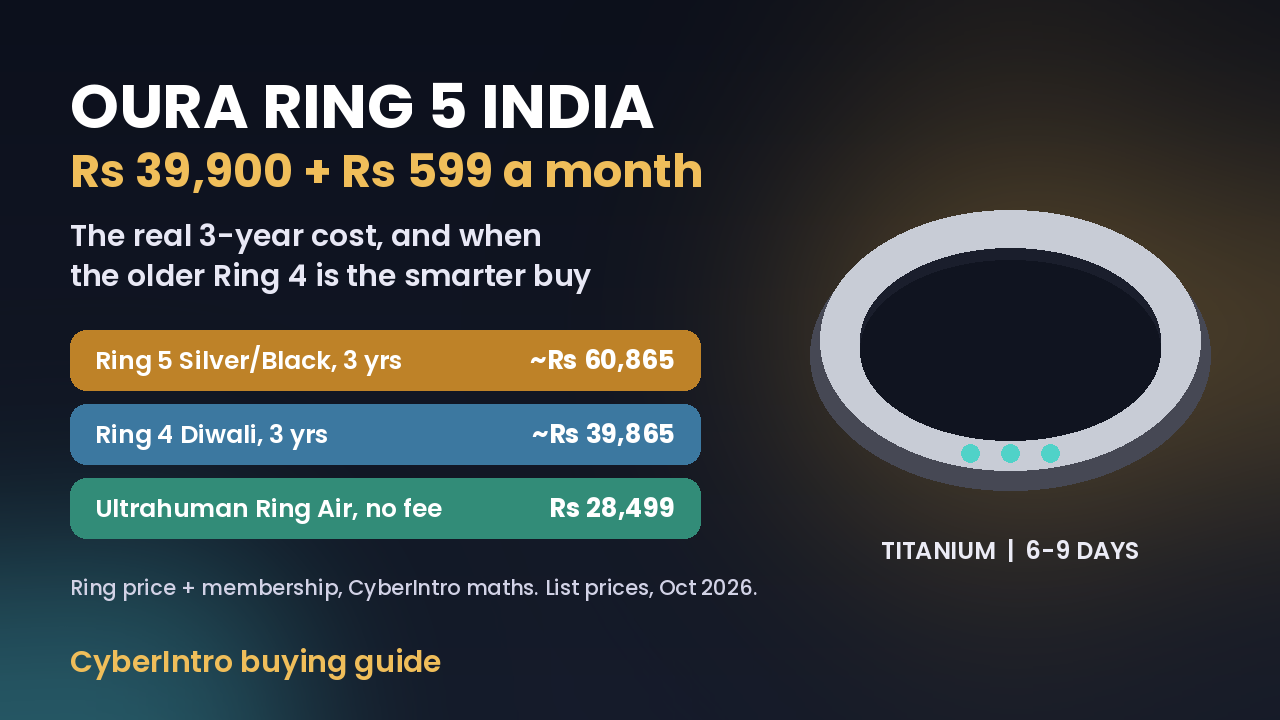
The Oura Ring 5 India launch went live on 22 October, and the sticker looks simple enough: Rs 39,900 for Silver or Black, Rs 50,900 for the fancier finishes, on pre-order through Amazon and Croma. But Oura does not really sell you a ring. It sells you a ring plus a Rs 599 monthly habit, and that habit is where the real price hides. So we ignored the launch hype and did one thing: worked out what this ring actually costs you over three years, and what else that money could buy.
Short version before the maths: the Ring 5 is the nicest Oura yet, but for a lot of people in India the smartest Oura purchase this month is not the Ring 5 at all. Read on and our 5-question Ring Rent Test at the end will tell you which bucket you fall into.
Table of Contents
Oura Ring 5 India price and what you get
Here are the launch prices and the bits that matter on the spec sheet:
- Silver and Black: Rs 39,900
- Gold, Deep Rose, Stealth and Brushed Silver: Rs 50,900
- Oura Membership: Rs 599 a month, first month included for new members
- Build: titanium, about 40 per cent smaller than the Ring 4, with a tougher PVD coating
- Battery: rated six to nine days, depending on size and use
- Water and dust: IP68, water resistant to 100 metres
- Sizes: 6 to 13, each with a size-specific charger in the box
Two details buried in the fine print are worth knowing. First, the slimmer band fits differently, so Oura wants every Ring 5 buyer to use the Ring 5 sizing kit, even if you already own an older Oura. Second, the optional charging case Oura sells abroad has not launched in India, so you get the regular charger and that is it. Not a dealbreaker, just do not plan around it.
The Rs 599 habit, explained
Without an active membership, the Oura app gives you only limited functionality. The detailed sleep, readiness and health insights that make people buy an Oura in the first place sit behind the subscription. So treat the membership as part of the price, not as an optional extra.
The good news most launch coverage skipped: Oura’s Amazon listing also offers an annual prepaid option at Rs 6,999. Twelve monthly payments would cost Rs 7,188, so going annual saves you just Rs 189 a year. That is not exactly a “double dhamaka” discount, but it does lock your cost for a year, which helps if Oura ever revises prices. Either way, the membership costs you roughly Rs 583 to Rs 599 every single month you wear the ring.
One more useful bit: the membership is tied to your Oura account, not to the ring. If you buy a second Oura later, you do not pay a second subscription.
The real 3-year cost, side by side
We picked three years because that is a fair ownership window for a gadget you wear 24 hours a day. For Oura, we assumed you use the free first month and then pay monthly for the remaining 35 months, which comes to Rs 20,965. Annual prepaid works out almost the same. Here is how the totals look (our maths, launch or listed prices):
- Oura Ring 5, Silver or Black: Rs 39,900 + Rs 20,965 = about Rs 60,865, or roughly Rs 56 a day
- Oura Ring 5, premium finishes: Rs 50,900 + Rs 20,965 = about Rs 71,865, or roughly Rs 66 a day
- Oura Ring 4, Silver or Black at the Diwali price: Rs 18,900 + Rs 20,965 = about Rs 39,865, or roughly Rs 36 a day
- Ultrahuman Ring Air at its Rs 28,499 list price: no recurring fee, so about Rs 26 a day
- Samsung Galaxy Ring at its Rs 38,999 India launch price: no subscription for core tracking, so about Rs 36 a day, Android only
- Google Fitbit Air: Rs 13,999, or up to about Rs 29,000 if you keep Google Health Premium (Rs 4,999 a year after the three-month trial) for all three years
Stare at the Ring 4 line for a second. A Ring 4 at its Diwali price plus three full years of membership costs about the same as the Ring 5 sticker alone. That is the whole story of this launch in one sentence.
Also notice how big the subscription slice is. On a Silver Ring 5, membership is about 34 per cent of your three-year bill. With a no-fee ring, that slice is zero. Rings from Ultrahuman and Samsung often sell below their list price too, so check live prices before you decide. Our guide to decoding festive effective prices explains why the price on the banner and the price you pay are rarely the same number.
Ring 5 vs Ring 4: what the extra Rs 21,000 buys
The Ring 4 launched in India in March at Rs 28,900 for Silver and Black. Its Diwali offer brings that down to Rs 18,900, with premium finishes at Rs 24,900, until 5 November on Amazon and Croma. So on the base finishes, the Ring 5 costs Rs 21,000 more. Here is what that money gets you:
- Size: 6.09mm wide and 2.28mm thick on the Ring 5, against 7.9mm and 2.88mm on the Ring 4
- Battery: six to nine days rated, against five to eight days
- Coating: the Ring 5’s PVD finish is Oura’s most scratch-resistant yet
- Sensors: redesigned LEDs and sensor domes for better skin contact
And here is what it does not get you: most of the new software. Health Radar features like Blood Pressure Signals and Nighttime Breathing, plus GLP-1 Insights, work in India on the English app for Gen3 and newer rings, which includes the Ring 4. So the headline launch features are not Ring 5 exclusives.
A reality check on those health features: Oura says the ring is not a medical device. Blood Pressure Signals looks at overnight trends, it does not give you a reading in mmHg. If you are managing BP, keep your cuff and your doctor. The ring can nudge you to check, nothing more.
The sizing catch that decides it for some people
The Ring 5 comes in sizes 6 to 13. The Ring 4 goes from 4 to 15. If your finger needs a 4, 5, 14 or 15, there is simply no Ring 5 for you, and the Ring 4 deal becomes the obvious move. Use the sizing kit before you spend a rupee, because ring sizes from your jeweller do not map neatly to Oura sizes.
What about rings with no subscription?
This is where Indian buyers have a real choice. Ultrahuman says its Ring Air has no recurring subscription fee for accessing your data, and it works with both Android and iPhone. Samsung’s Galaxy Ring also skips a subscription for core health tracking, but it pairs only with Android phones, and its Galaxy AI features want a Samsung phone. If you carry an iPhone, cross the Galaxy Ring off your list right now.
Then there is the wildcard. Google’s Fitbit Air is not a ring at all. It is a screenless band that went on sale in India on 2 October at Rs 13,999, tracks heart rate, sleep and SpO2, and still keeps basic activity and sleep data free if you skip Premium. If what you really want is “tell me how badly I slept” without paying ring money, this is the value ki dukan option.
Our honest take: Oura’s app and insights are why people pay the premium, and many owners love them. But “best app” is worth paying for only if you actually use it. Paying Rs 7,000 a year to look at a sleep score you ignore is not wellness, boss, it is a donation.
Paying for it smartly
If you do go Oura, a few small moves keep the bill sane:
- Start monthly, switch to annual later. Use the free month, then a couple of paid months, and only prepay Rs 6,999 once you know you are hooked. The annual saving is too small to justify paying upfront for a habit you have not tested.
- Set a calendar reminder. Subscriptions renew quietly. Put a reminder a few days before each renewal and ask yourself if you opened the app last week.
- Read the EMI fine print. Ring listings show EMI options, and a “No Cost” tag does not always mean zero extra. Our No Cost EMI hidden charges breakdown shows where the extra rupees hide.
- Size first, pay second. A wrong-size ring is the most expensive mistake here, because it either sits loose and reads badly or sits in a drawer.
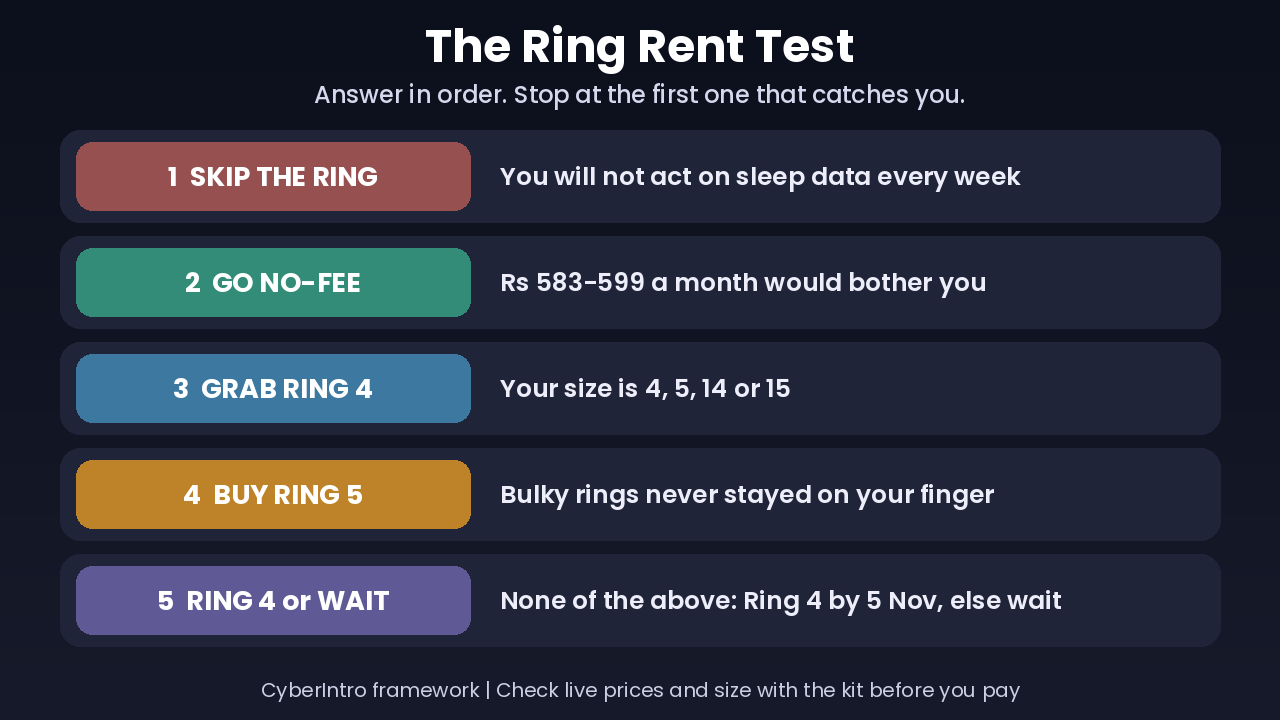
The Ring Rent Test: 5 questions
Go in order and stop at the first answer that catches you.
- Will you check your sleep and recovery data and actually change something, at least a few times a week? If no, SKIP THE RING. A Fitbit Air without Premium, or the watch you already own, covers casual curiosity.
- Would Rs 583 to Rs 599 a month bother you after the novelty wears off? If yes, GO NO-FEE. Look at the Ultrahuman Ring Air, or the Galaxy Ring if you use an Android phone, ideally a Samsung.
- Is your Oura size 4, 5, 14 or 15? If yes, GRAB RING 4 before the Diwali price ends on 5 November. The Ring 5 does not come in your size.
- Have you skipped wearing a ring before because it felt bulky, in the gym, at work or in bed? If yes, BUY RING 5. The slimmer body is the one upgrade you will feel every day, and it is the main thing the extra Rs 21,000 buys.
- None of the above? GRAB RING 4 at Rs 18,900 if you can order before 5 November. Missed it? WAIT for proper Ring 5 reviews from Indian users before spending Rs 39,900.
Final Thought
The Oura Ring 5 is a genuinely nicer ring: smaller, tougher and a bit longer on battery. But in India right now, its biggest rival is its own older sibling. A Ring 4 at the Diwali price with three years of membership costs about what the Ring 5 costs before you have paid a single month. Buy the Ring 5 if comfort is the thing that keeps a ring on your finger. Grab the Ring 4 if you just want the Oura experience at a sane price. And if subscriptions make you twitch, a no-fee ring is the paisa vasool path. Whatever you pick, size it first and be honest about whether you will open the app.