
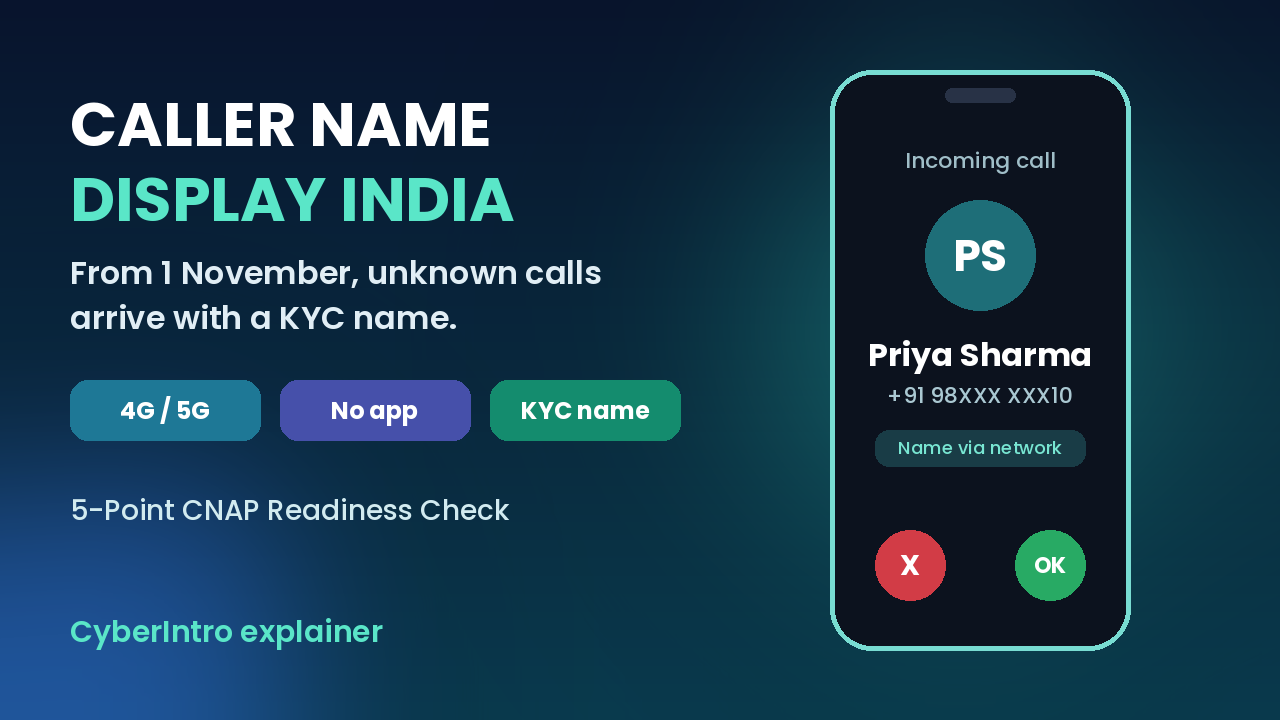
From 1 November 2026, the unknown number ringing your phone will finally come with a name attached. That is the short version of the caller name display India is getting: the Department of Telecommunications (DoT) has told Jio, Airtel, Vodafone Idea, BSNL and every other access provider to switch on Calling Name Presentation, or CNAP, across all service areas from that date. No app, no opt-in, no “allow contacts” popup. The network itself will push the caller’s KYC-registered name to your screen.
Sounds like free Truecaller, right? Partly. But there is a catch most people will only discover on 1 November, when their mom calls a school teacher and the screen says their dad’s name. So instead of another “government launches feature” recap, here is the CyberIntro take: a 5-point readiness check you should run in the next two weeks, plus an honest verdict on whether your caller ID app is about to become useless.
Table of Contents
What caller name display India actually means from November 1
The order is DoT Circular no. 01/Licensing Policy/2026, dated 13 October 2026. It builds on TRAI’s CNAP recommendations from February 2024 and DoT’s November 2025 instructions on fixing KYC mismatches. Strip away the licence language and this is what lands on your phone:
- Who gets it: calls on 4G and higher (VoLTE/5G) wireless networks. 2G, 3G and landlines will be “considered separately” later, so feature-phone users on old networks should not expect names yet.
- Do you need to ask? No. Operators must provide it to every user without a separate request.
- What shows: two fields. The number, exactly like today, and a name.
- Which name wins: if you have saved the number, your saved contact name shows. If not, a domestic call shows the name in the caller’s operator records. International calls simply show “International Call”.
- Who stays hidden: anyone who has taken the Calling Line Identification Restriction (CLIR) facility under existing rules. Their name is not presented.
- Privacy guardrail: the circular asks for a “security-by-design” lookup, where the receiving operator queries the caller’s operator and the name is not retained once the call ends.
Economic Times also reports that handset makers have been told to push software updates to support the feature. So the network side and the phone side both need to be ready. Keep that in mind for step 3 below.
The family SIM problem nobody is talking about
Here is where it gets very Indian. CNAP shows the name on the SIM’s paperwork, not the name of the person actually holding the phone. And a huge number of us use SIMs bought years ago on a parent’s Aadhaar, a spouse’s ID, a company account, or that one cousin who “had the documents ready”.
Unsaved recipients will see that registered name. So your delivery guy, your new landlord, the HR person calling back about the interview, all of them see “Ramesh Kumar” when you are Priya. Awkward at best. At worst, it looks exactly like the kind of mismatch that makes people suspect a scam call, which is the opposite of what this feature is meant to do.
Fixing it is not a two-click job either. Under long-standing DoT rules (as quoted in TRAI’s 2024 paper), you cannot simply rename a SIM, because SIMs are not transferable. A switch between blood relatives or legal heirs is allowed, but it needs a fresh Customer Application Form, full new-subscriber KYC, a new SIM and an NOC from the original holder, and the connection is then treated as new. Genuine legal name changes are a separate track, backed by government-issued ID. Ask your operator store exactly what happens to your number, plan and any linked services before you start.
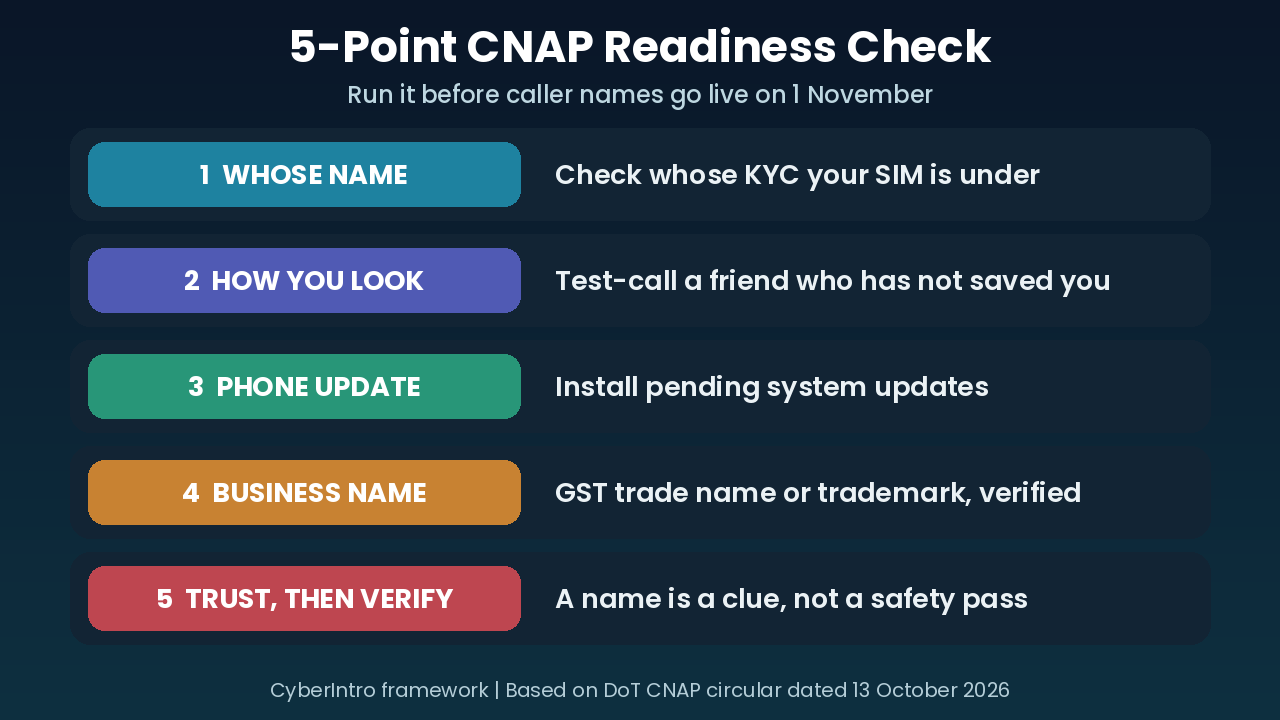
The CyberIntro 5-Point CNAP Readiness Check
Ten minutes now saves a month of “who is this?” later. Run these in order.
1. WHOSE NAME
Find out whose name each of your numbers is actually registered under. Your operator app or store can confirm the subscriber name on the account. Also worth a look: the mobile-connections-in-your-name check on the government’s Sanchar Saathi portal lists numbers issued against your ID, which is handy for spotting old SIMs you forgot existed. If the name is a parent’s or an ex-employer’s, decide now whether that is fine or whether you want to move the connection into your own name.
2. HOW YOU LOOK
Once 1 November hits, do a simple test. Ask a friend who has not saved your number (or who temporarily deletes you) to take a call from you on a 4G/5G network. Screenshot what they see. That screenshot is the real answer to “what will people see when I call?”, and it beats guessing based on old KYC memories.
3. PHONE UPDATE
Install pending system updates in the second half of October. If your brand rolls out CNAP support as an update, you want it before the switch flips, not after a week of blank names. Phones stuck on very old software, or older devices that only drop to 3G, may not show anything at all.
4. BUSINESS NAME
Shop owners, clinics, tuition centres and small agencies, listen up. The circular lets business and bulk connections show a preferred name instead of the personal KYC name, but only if that name is a registered trademark in your name or your trade name on the GST portal, and only after your operator verifies the documents. Existing connections need to apply through the operator’s process. If customers currently see “Suresh” when “Suresh Mobile Repairs” calls, this is your fix. Ask your operator’s business desk which documents they want.
5. TRUST, THEN VERIFY
A name on screen is not a safety certificate. CNAP shows the name on the SIM’s KYC record. A SIM obtained with someone else’s documents, or a mule SIM rented out by a real person, will still carry a real-looking name, so a named caller can still be a scam call. Treat it as one extra clue, not a green signal. The old rules still apply: no OTPs, no screen-sharing apps, no “urgent” KYC updates over a call. For a fuller drill, our festive sale scam safety setup covers the 1930 cyber fraud helpline and Chakshu reporting on Sanchar Saathi, and our explainer on how SIM swapping works shows why your SIM is worth guarding.
So, do you still need Truecaller?
Short answer: fewer people will need it, but it is not dead on day one. Here is the honest scorecard.
Where CNAP wins
- Source of truth: the name comes from operator KYC records, not crowd-sourced contact lists where someone saved your plumber as “Pappu No Pick”.
- No app, no permissions: you do not have to hand your entire contact book to a third-party app just to see who is calling.
- Works by default: your parents get it without installing anything, which honestly matters most.
Where an app still helps
- Spam tags: CNAP shows a name, not a “reported 3,000 times as loan spam” warning. Community spam labels are still the app’s strongest card.
- Coverage gaps: CNAP is starting with 4G and above. 2G/3G, landlines and international calls (“International Call” only) are outside the name display for now.
- App calls: WhatsApp and other internet calls do not run through the telecom caller ID system, so CNAP does nothing there.
CyberIntro verdict: if you mostly wanted Truecaller to see names of unknown Indian callers, give CNAP a month and you may happily uninstall. If spam blocking is your main reason, keep a spam filter (your phone’s built-in one or an app) until operators show what CNAP plus their own spam tools can do together. Dono ka combo, at least for now.
Quick FAQ
Is caller name display India free?
The circular directs operators to provide the service to every user without a separate request. It does not set a separate charge for receiving names. If your operator ever tries to bundle it as a paid add-on, that is worth questioning.
Can I hide my name?
Users who have availed CLIR under existing guidelines will not have their name shown. Availability and eligibility for CLIR depend on the operator and the rules, so check with yours.
Will my saved contacts change?
No. Your saved contact name always takes priority over the network name.
Final Thought
CNAP is a genuinely good, overdue change. Network-verified names should cut down a lot of “hello, kaun?” moments and make lazy spoofing harder. But it only works as well as the KYC behind it. So spend ten minutes this month: check whose name your SIM wears, update your phone, sort the business name if you run a shop, and keep your scam radar switched on. When the switch flips on 1 November, you want people to see you, not your papa.