
That “No Cost EMI” badge on the checkout page looks like free money, right? Phone today, pay later, zero interest. But here is the plot twist this festive season: no cost EMI hidden charges are very real, and they can quietly add a few hundred rupees (sometimes more) to a gadget you thought you got at the sticker price. So before you split that new phone or TV into six neat instalments, let us do the maths together, CyberIntro style.
Table of Contents
What “No Cost EMI” Actually Means
First, the uncomfortable truth: the bank almost never lends you money for free. In a typical no-cost EMI deal, your card issuer still charges interest on the loan. The seller or brand simply knocks an equal amount off the price upfront, so the interest and the discount cancel each other out. Razorpay’s merchant documentation spells this out plainly: the discount is sized to cover the bank’s interest, which makes the effective interest zero.
Notice the word “effective”. The interest still exists on paper, and anything charged on top of that interest is your problem, not the seller’s.
The Three Sneaky Add-Ons
1. GST on the interest
Banking and financial services attract 18% GST in India, and that includes the interest component of a credit card EMI. ICICI Bank’s card terms, for example, state that 18% GST is charged on the interest portion of EMIs. The merchant’s discount wipes out the interest, but it does not wipe out the tax on that interest. That tax lands on your card statement.
2. Processing fee, plus GST on that too
Many issuers charge a one-time fee for converting a purchase into EMI. ICICI’s Instant EMI terms list a processing fee of 2.99%, capped at Rs 299, plus 18% GST. Other banks and special campaigns have their own numbers, so always read the fine print on your own card.
3. The lost cashback and rewards
This one hurts silently. Some EMI terms exclude reward points, and an instant bank discount offered for full payment may be different (or missing) on the EMI route. You might “save” interest and lose a Rs 1,500 card discount in the same click. Ouch.
Let Us Run the Numbers (Illustrative Example)
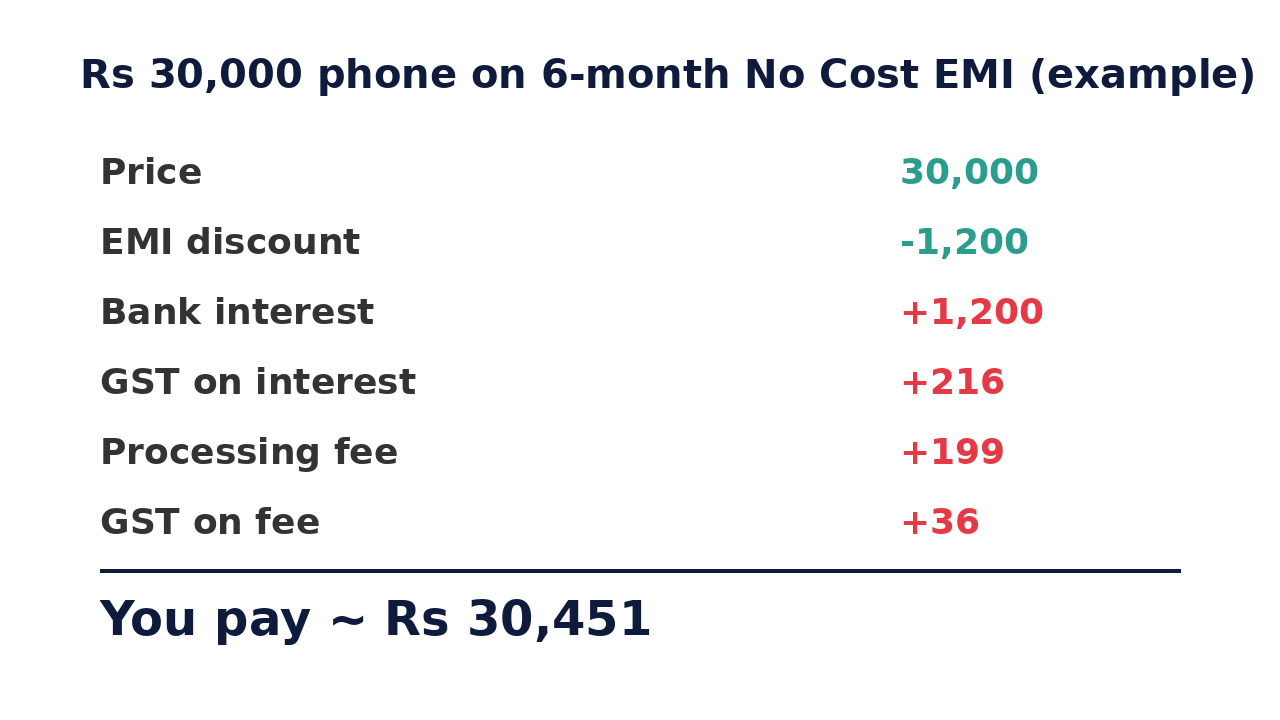
Here is a made-up but realistic example so you can see how it stacks up. Say you pick a Rs 30,000 phone on a 6-month no-cost EMI, and assume the bank’s interest over the tenure works out to about Rs 1,200. The seller gives a Rs 1,200 upfront discount to cancel it. Now add the extras, using an assumed Rs 199 processing fee:
- Product price: Rs 30,000
- Merchant EMI discount: minus Rs 1,200
- Bank interest over 6 months: plus Rs 1,200
- GST at 18% on interest: plus Rs 216
- Processing fee: plus Rs 199
- GST at 18% on the fee: plus about Rs 36
- Total you actually pay: roughly Rs 30,451
So your “zero cost” plan costs about Rs 450 extra, around 1.5% of the price. Not a disaster, but not free either. On a Rs 1 lakh laptop over 12 months, the interest component is bigger, so the GST on it grows with it. Bigger ticket, longer tenure, bigger hidden bill. Simple.
Your real numbers will differ by bank, tenure and offer, so treat this as a template, not a quote.
The CyberIntro 4-Number Check Before You Click Buy
Before you confirm any EMI order this festive season, write down these four numbers. Takes two minutes, saves real paisa.
- Full-payment effective price: the price after any instant bank discount or cashback if you pay in one go.
- Total of all EMIs: the instalment amount multiplied by the number of months.
- Processing fee plus GST: check the issuer’s terms or the EMI summary screen.
- GST on interest: ask for or compute the interest schedule, then take 18% of the interest.
Add 2, 3 and 4. Compare that with number 1. Whichever is lower wins. No emotional decisions, only arithmetic.
When No Cost EMI Is Genuinely Worth It
- Your cash is better parked elsewhere. If the money sits in an FD or liquid fund earning more than the small extra cost, spreading payments can still make sense.
- The EMI route keeps the same bank discount. Some sale offers apply the instant discount on EMI too. Then the only extra cost is GST and the fee.
- Short tenure, small fee. A 3-month plan has less interest, so less GST on interest. Keep the tenure as short as your budget allows.
- You will never miss a due date. EMI blocks part of your card limit, and missing the total amount due on a card can trigger hefty card interest. Disciplined users only.
When You Should Just Pay in Full
- The full-payment bank discount is bigger than what you would earn by keeping the cash.
- You plan to return or exchange the product soon. Refunds and pre-closure of EMI can get messy, and fees already charged may not come back.
- Your credit utilisation is already high. A big EMI blocking your limit can nudge your credit score the wrong way.
- You are buying “because EMI is easy”, not because you need the gadget. Ye wala trap sabse common hai.
Quick Tips for the Sale Days
- Screenshot the EMI breakup screen at checkout. If the statement later shows surprises, you have proof for a dispute.
- Check your next card statement for the interest, GST and fee lines. Small errors do happen.
- If you are trading in an old phone with your purchase, run the exchange maths separately. We broke that down in our exchange vs sell vs keep guide.
- Lock your card down before the sale rush. Our 15-minute festive sale safety setup shows how to cap card limits and stay scam-proof.
- Paying via UPI instead? Read what changes for payments in our UPI MDR explainer.
Final Thought
No Cost EMI is not a scam, but it is also not a gift. Think of it as “low cost EMI” and you will never be disappointed. Do the 4-number check, compare it with the full-payment price, and let the cheaper total win. Sale ka maza tab hai jab bill bhi smile kare.