Technology
NavIC Is Back to Four Satellites: Does Your Phone Actually Use India’s GPS?
Friday night at 11:51pm, while most of us were busy arguing about Diwali shopping lists, ISRO quietly put NVS-03 into orbit. The headline everyone repeated: NavIC, India’s own satellite navigation system, is back to its minimum four working satellites. Great news. But here is the question nobody answered for normal phone owners: does NavIC phone support exist on the phone in your pocket, and if it does, will you even notice? Chalo, let us sort it out properly, with a test you can run in about two minutes.
Table of Contents
What actually happened on 30 October
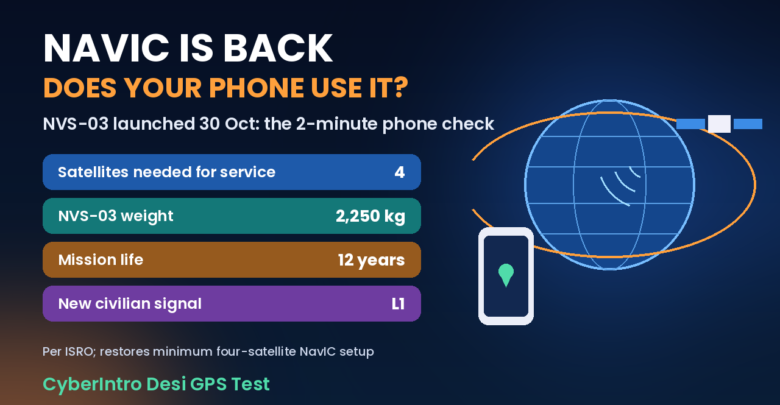
Quick recap before we get to your phone. A GSLV-F18 rocket lifted off from the second launch pad at Sriharikota on 30 October 2026 and placed NVS-03 into a geosynchronous transfer orbit roughly 18 minutes later. The satellite is a hefty one and is meant to last a long time.
- Satellite: NVS-03, third of the second-generation NavIC satellites
- Weight: 2,250 kg
- Mission life: 12 years
- Signals: L1 civilian signal, plus the older L5 and S-band signals
- Clocks: an indigenous atomic clock along with procured ones
- Coverage: India and a region about 1,500 km beyond its borders
Why the drama around “four satellites”? NavIC has had a rough few years. Atomic clocks on older IRNSS satellites kept failing, NVS-02 never reached its intended orbit in 2025, and the last working clock on IRNSS-1F stopped on 13 March this year. ISRO chief V. Narayanan said three satellites were working before this launch, and NVS-03 brings the count to the four needed for position, navigation and timing services.
One honest caveat: a satellite in transfer orbit is not the same as a satellite serving your Maps app. It still has to reach its working slot and finish checks. In the reports we read, ISRO did not give a public date for when NVS-03 starts contributing signals, so treat “NavIC is fully back” as a work in progress, not a done deal.
The L1 twist that matters for phones
This is the bit most launch coverage skipped. Older NavIC satellites broadcast civilian signals on L5 and S-band. Your phone’s location chip, however, grew up listening mostly to L1, the same band classic GPS uses. That mismatch is a big reason NavIC stayed niche in phones for years: supporting it meant extra hardware work for an L5 signal that only some chips handled.
ISRO says all NavIC satellites from 2023 onwards broadcast a civilian L1 signal too, and Qualcomm has announced select chipsets that support NavIC L1. NVS-03 adds one more L1-capable bird to the sky. Over time, that makes it much easier for budget and mid-range phones to pick up NavIC without fancy extra radio parts.
But, bhai, a new satellite cannot install a missing receiver in your old phone. If your handset’s GNSS hardware never supported NavIC, no launch will change that. And if it supports NavIC only on L5, it will not suddenly start reading L1.
Is NavIC compulsory on phones now?
No. In a December 2025 parliamentary reply, the Department of Space said the government had not mandated NavIC yet, with discussions still ongoing. The same reply said more than 60 smartphone models from various brands supported NavIC at that point. That is a useful benchmark, not a full list, because new phones launch every week.
The Bureau of Indian Standards has also published standards for NavIC receivers, and BIS told Mint that getting a licence under them would initially be voluntary. So for now, NavIC on a phone is a feature brands choose to add, not a rule they must follow.
The CyberIntro Desi GPS Test
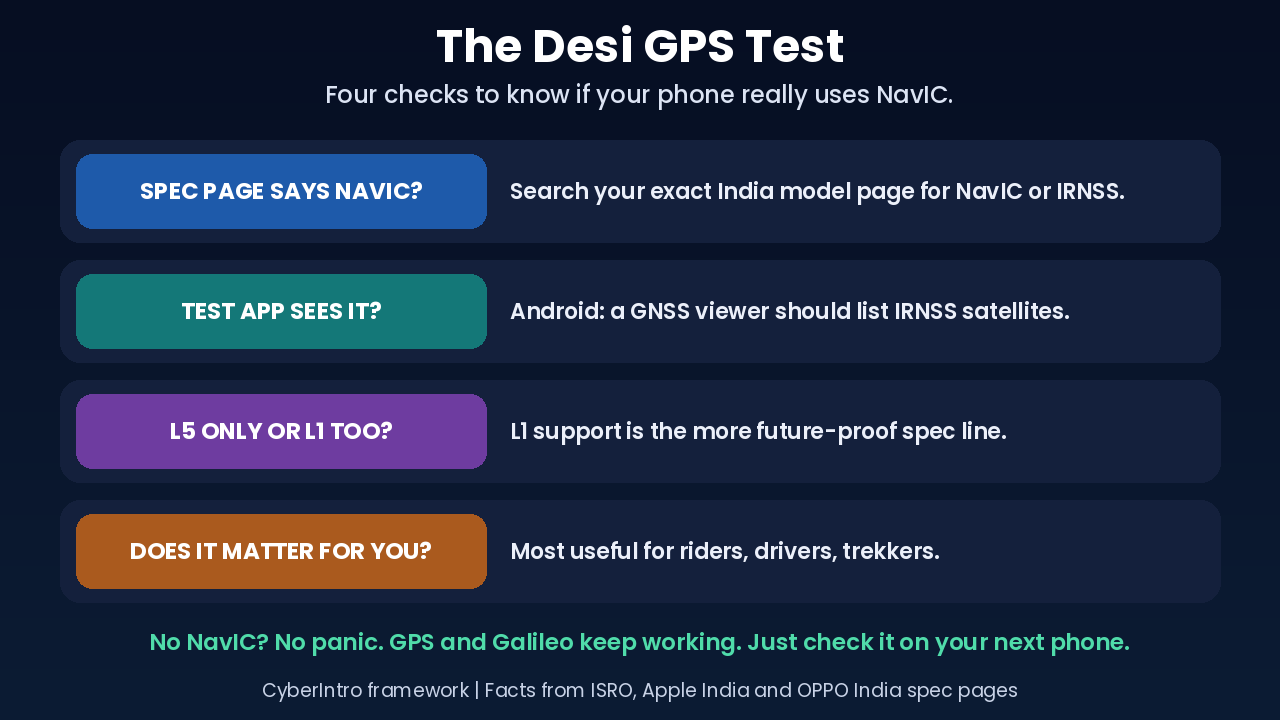
Spec sheets love to say “supports all major satellite systems” and leave it there. That is not good enough. Run these four questions instead, in this order.
1. Does the official spec page say NavIC?
Open your exact model’s India spec page, not a random listing, and search for “NavIC” or “IRNSS”. This one check already throws up surprises. Apple’s India spec page for iPhone 17 lists NavIC under location, next to GPS, GLONASS, Galileo, QZSS and BeiDou. The iPhone 16 page lists those other systems but not NavIC. Same brand, one year apart, different answer. So never assume support from the brand name.
2. Does a GNSS test app actually see NavIC satellites?
On Android, install a free satellite viewer such as GPSTest from the Play Store, step outside or stand near a big window, and let it lock on for a minute or two. Look for satellites labelled IRNSS or NavIC, usually with an Indian flag. If they show up with a signal strength, your phone is genuinely receiving them. iPhone owners cannot do this check, because iOS does not show per-satellite data to apps, so the spec page is your only proof.
3. Is it L5 only, or L1 as well?
Some spec sheets get specific. OPPO’s India spec page for the Find X9 Pro, for example, lists NavIC L5. Phones that support only L5 can still use the older NavIC satellites, but the new L1 signal from NVS-series satellites is where future support is heading. If you are buying a new phone in the next few months, a spec line that mentions NavIC L1 is the more future-proof one.
4. Will it change your daily life?
Honestly, for most city users, not dramatically. Phones blend several satellite systems together, so NavIC is one more voice in the choir rather than a replacement for GPS. Where it helps more is resilience: if a foreign system has issues or is degraded, a phone that also hears India’s own satellites has a backup. Delivery riders, cab drivers, truckers, trekkers and anyone who depends on location for work get the most value.
What to do with your result
Here is the CyberIntro take, sorted by what you found:
- Spec page says NavIC and the app sees it: Mubarak ho. Nothing to switch on. Your phone already mixes NavIC in when it is available.
- Spec page says NavIC, but the app shows nothing: try outdoors with a clear sky, wait a few minutes, and update your phone software. Some features arrive via firmware.
- No NavIC anywhere: do not panic and do not buy a new phone just for this. GPS, Galileo and friends will keep working fine.
- Buying a phone soon anyway: add “NavIC, ideally L1” to your checklist, right next to update policy and charger support. It costs nothing to check and adds a backup layer for years.
And please ignore any forward claiming “turn on NavIC in settings to get 10x better accuracy”. There is usually no such toggle on Android or iPhone. The phone decides which satellites to use on its own. If an app or message asks you to install something random to “activate NavIC”, treat it like any other scam. Our phone safety setup guide covers the basics.
Why this launch still matters to you
NavIC is not only about Maps. The ISRO chairman pointed to train tracking, vehicle and ship tracking, and the One Nation One Time project, which relies on accurate timing. The December 2025 government reply mentioned more than 10,000 trains with NavIC-enabled tracking devices and NavIC devices fitted in more than 15 lakh vehicles. So even if your phone never sees a NavIC satellite, the “where is my train” estimate or your cab’s tracking may already be leaning on it.
ISRO also says NVS-04 and NVS-05 are planned in roughly five and ten months. If those launches go well, the system moves from “just enough” to having some breathing room, which is when phone brands have a stronger reason to push NavIC L1 into cheaper models.
Until then, the smart move is simple: know what your phone supports, check it when you buy your next one, and ignore the hype in both directions. Same logic as our 10,000mAh phone guide: the real value ki dukan is often hiding in the spec lines nobody reads.
Final Thought
NVS-03 is a proper win for Indian space tech and a necessary repair job for NavIC. For your phone, though, the launch is a reminder, not a magic upgrade. Spend two minutes on the Desi GPS Test, find out where your handset stands, and make “NavIC L1” one of your quiet tie-breakers on the next phone purchase. Desi satellites are back in the game. Make sure your phone is listening.