Gadgets
Car Charger India: Why 96W on the Box Is Not 96W for Your Phone
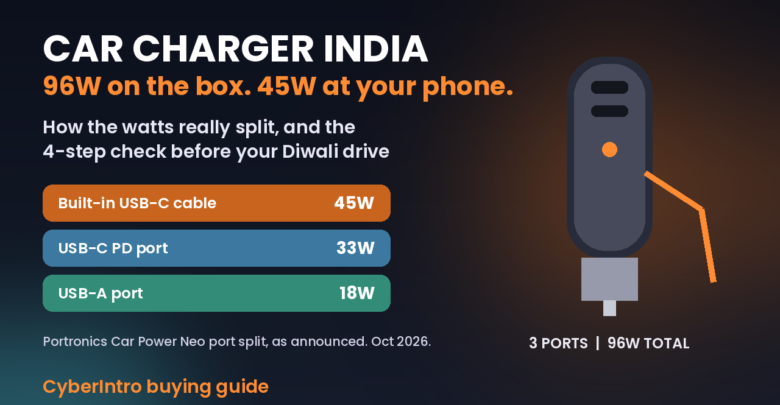
Planning a long Diwali drive home? Before you grab the first car charger India listing that shouts a giant wattage number, read this. This week Portronics launched the Car Power Neo, a 96W car charger with a retractable cable, at an offer price of Rs 1,349 (MRP Rs 2,499). Nice gadget. But that 96W figure is a perfect example of how car chargers are sold: one big number on the box, and a very different number at your phone’s charging port.
So instead of a launch rewrite, we did what CyberIntro does. We broke the watts apart, worked out what one phone, two phones and a laptop actually get, and built a 4-step Car Charger Check you can run on any listing in about two minutes.
Table of Contents
The Portronics Car Power Neo, in numbers
Here is what Portronics has announced:
- Total output: up to 96W combined
- Built-in cable: retractable USB-C, about one metre, rated up to 45W
- Extra USB-C port: Power Delivery (PD), up to 33W
- USB-A port: up to 18W
- Devices at once: three
- Protection: overcharge, short-circuit, under-voltage and temperature monitoring
- Price: Rs 1,349 offer, Rs 2,499 MRP, on the Portronics site, Amazon.in, Flipkart and offline stores
- Warranty: 12 months
Now do the simple sum: 45 + 33 + 18 = 96. That is where the 96W comes from. It is the total of all three outlets running flat out together, not what any single device gets.
Why 96W never reaches your phone
Think of a car charger like a thali. The menu says “96 items worth of food”, but your plate only holds what your plate holds. Each port has its own ceiling, and your phone can only drink from one port at a time.
One phone in the car
Plug into the built-in cable and the best case is 45W. That is it. Even if your phone supports 80W or 100W at home, the car charger cannot push more than its port ceiling.
The brand charging catch
Here is the bit most buyers miss. Many phones sold in India hit their headline speeds only with the brand’s own charging tech and brick. On a generic charger they fall back to a standard like USB PD or PPS, and the speed you get depends on what the phone supports over that standard, which is often well below the number on its launch poster. So a phone advertised with 80W charging might charge at a far lower rate from any third-party car charger. Check your phone’s spec page for “PD” or “PPS” support and the wattage listed against it. That number, not the headline, is your real ceiling.
Two phones and a pair of earbuds
This is where a three-port charger earns its keep. Driver on the 45W cable, co-passenger on the 33W PD port, kid’s earbuds or an old phone on the 18W USB-A port. Everyone charges, nobody fights over the socket. Just remember that USB-A at 18W is slow for a modern phone, so give it to the gadget that matters least.
The laptop dream
Portronics says compatible USB-C laptops are supported, and on the 45W cable that is true for many thin laptops. But plenty of thin laptops ship with 65W bricks. On 45W they will charge slower, and if you are working hard, the battery may only hold steady rather than fill up. Fine for topping up between toll plazas, not for a full charge in an hour.
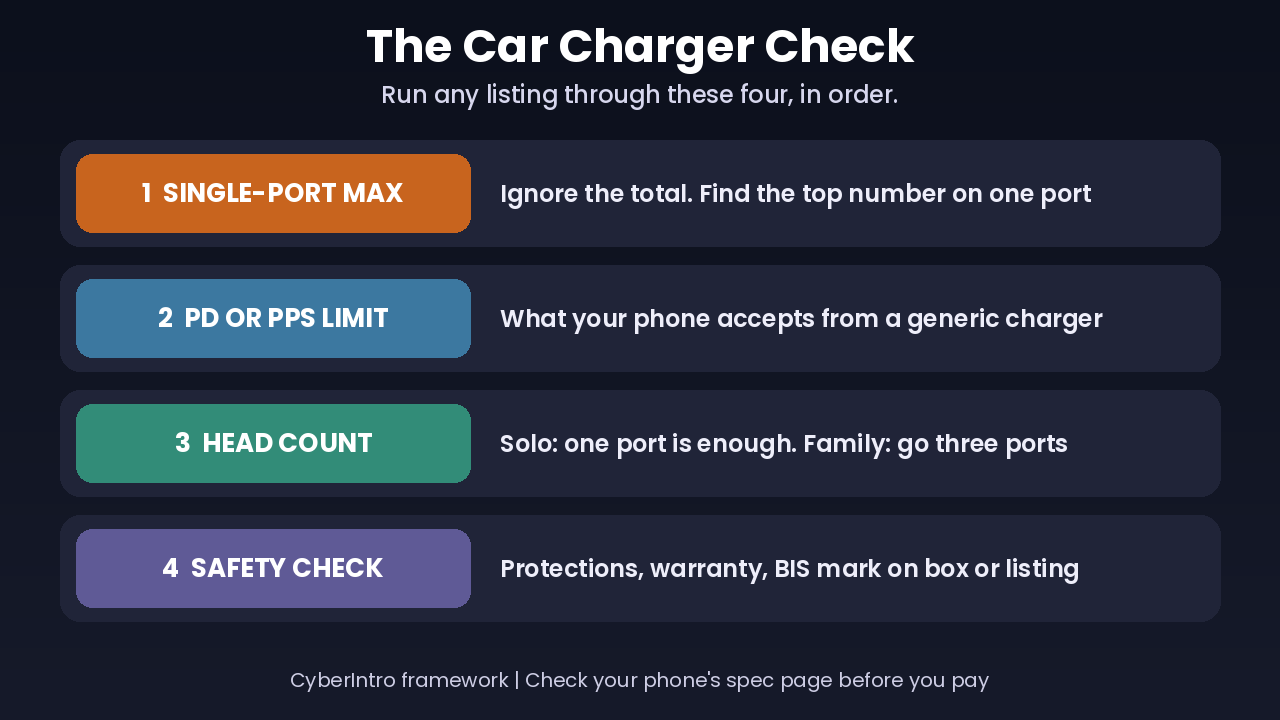
The CyberIntro Car Charger Check
Run any car charger listing through these four questions, in order. Kisi bhi brand ka ho, the logic stays the same.
1. What is the single-port maximum?
Ignore the total. Find the highest number printed against one port. If the listing only shows a combined figure and hides the per-port split, that is a red flag. Skip it.
2. What does your phone accept over PD or PPS?
Look up your phone’s standard charging support. If it tops out at around 25W to 30W over PD, then a 45W port and a 100W port will feel almost the same in daily use. Do not pay extra for watts your phone cannot use.
3. How many people charge at once?
Solo commuter? A good single-port charger is enough. Family road trip with two or three phones? Then a three-port unit like the Car Power Neo makes sense, as long as each port gives enough for the device that sits on it.
4. Is the safety story real?
A car socket is a rough place: voltage dips while cranking, heat in a parked car, bumpy roads. Look for clear protection features, a brand you can claim warranty from, and a registration mark from BIS (Bureau of Indian Standards) on the box or listing. A no-name Rs 199 charger that cooks a Rs 40,000 phone is the most expensive charger you will ever buy.
Is the Car Power Neo a good buy at Rs 1,349?
For the right car, yes. At the offer price you get three outlets, a cable that cannot be left at home, and a 45W top port that covers most phones’ standard charging speeds and some light laptops. The retractable cable is the real feature here. Half the battle on a road trip is finding the cable that slipped under the seat.
Where we would hold back: if you only ever charge one phone, a single-port 45W charger plus a decent cable you already own may do the same job for less. And at the Rs 2,499 MRP, the value ki dukan argument gets weaker, so buy it while the offer price holds, or compare it with other three-port options on Amazon and Flipkart first.
Road trip charging habits that actually help
- Start the engine, then plug in. The cranking voltage dip is the roughest moment for any charger.
- Keep the phone off the dashboard. A phone baking in the sun while charging and running maps will throttle its own charging speed.
- Unplug when parked. In some cars the socket stays live with the engine off, which slowly drains the car battery.
- Carry a power bank anyway. Dhaba stops and ghat sections do not care about your charging plan. If battery life is your worry, our 10,000mAh phone maths is worth a read too.
Shopping for this before the festival rush? Our guide on festive delivery delays explains what to do if your order gets stuck in hub-loop hell, and our effective price guide helps you see through stacked “from Rs” ads.
Final Thought
Watts on the box are marketing. Watts at your port are reality. Find the single-port maximum, match it to what your phone accepts over PD or PPS, count your passengers, and insist on real safety features. Do that, and a Rs 1,349 car charger can be a smart road trip buy. Skip it, and you are paying for 96W of hope.