
Gadgets
iPhone Duo India: Is Apple’s Rs 2,99,900 Foldable Worth It Over the Pro Max?
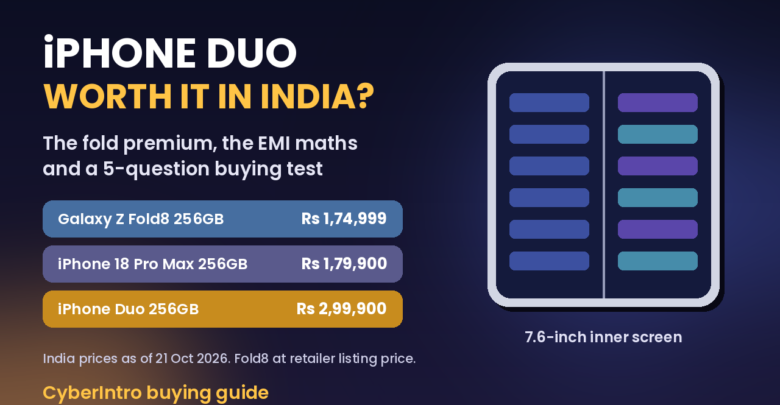
The iPhone Duo India price is finally out there in black and white: Rs 2,99,900 for the base 256GB model, and it goes on sale this Friday, 23 October. That is Apple’s first foldable, and yes, that is three lakh rupees minus one hundred. Pre-orders have been open since 16 October, so the question in a lot of WhatsApp groups right now is simple. Do you book it, or do you buy the iPhone 18 Pro Max for Rs 1,20,000 less and call it a day?
We are not going to give you another spec sheet read-out. Instead, we worked out what the fold actually costs you over the Pro Max, what you quietly give up to get it, what the EMI really looks like, and how it stacks up against the Android foldables already on Indian shelves. Then we built a 5-question Duo or Don’t Test. Spoiler: most people reading this should not buy it. But a small, very specific group absolutely should.
Table of Contents
iPhone Duo India price and variants
Apple lists four storage options in India, all at MRP inclusive of taxes:
- 256GB: Rs 2,99,900
- 512GB: Rs 3,24,900
- 1TB: Rs 3,74,900
- 2TB: Rs 4,49,900
Colours are Star White and Night Sky. It is sold on Apple’s India online store and at selected partner stores from 23 October, and you can see one at any Apple Store before you commit. Apple’s site shows instant cashback with eligible American Express, Axis Bank and ICICI Bank cards, which works out to Rs 7,000 on the Duo based on Apple’s own monthly figures.
What the money gets you
The headline is the screen. Here are the bits that matter, straight from Apple’s listing:
- Inner display: 7.6-inch Super Retina XDR folding panel with a nano-texture anti-glare finish, about 50 percent larger than the iPhone 18 Pro Max screen
- Outer display: 5.4-inch, so it works like a normal compact phone when shut
- Both screens: up to 120Hz ProMotion and up to 3,000 nits peak brightness
- Chip: A20 Pro with a vapour chamber, the same chip family as the 18 Pro models
- Cameras: 48MP Fusion Main plus 48MP Fusion Ultra Wide, 12MP front camera, and an under-display camera on the inner screen
- Battery: dual-battery design, up to 31 hours of video on the inner screen and 44 hours on the outer one, around 50 percent in 20 minutes with a 60W-class USB-C charger
- Build: Grade 5 titanium frame and hinge cover, Ceramic Shield front and back, IP68
- Unlock and SIM: Touch ID in the side button, and eSIM only
Apple Pencil (USB-C) support is listed as coming later this year, so do not buy it today for note-taking alone.
The fold premium: what Rs 1,20,000 extra really buys
Here is the cleanest comparison. The iPhone 18 Pro Max 256GB costs Rs 1,79,900. The iPhone Duo 256GB costs Rs 2,99,900. Same storage, same chip family, same Apple ecosystem. The difference is exactly Rs 1,20,000, and that is the price of the fold.
Spread it over three years, which is a sensible holding period at this price, and the Duo costs you about Rs 274 a day against roughly Rs 164 a day for the Pro Max. So the fold is around Rs 110 a day extra. Think of it as a daily filter coffee plus samosa, every single day, for three years, just for a bigger screen. Some people will happily pay that. Most should be honest about whether they will open the phone enough to feel it.
What you give up for the fold
This is the part the ads will not shout about. Going by Apple’s own comparison, the Duo is not a Pro Max with a hinge. It drops a few things:
- Zoom: the Duo tops out at 2x optical-quality zoom. The 18 Pro Max has a 48MP telephoto with up to 8x optical-quality zoom. If you shoot your kid’s annual day from the back row, this one matters.
- Variable aperture: the Pro Max main camera gets Apple’s first variable aperture. The Duo does not.
- Front camera: 12MP on the Duo versus 18MP on the 18 Pro models.
- Face ID: the Duo uses Touch ID instead. Some people will love this with a mask or helmet on, others will miss looking-to-unlock.
- Physical SIM: none. It is eSIM only, worldwide.
So the honest framing is this: you pay Rs 1.2 lakh more and accept a weaker camera kit in exchange for a tablet-sized screen in your pocket. That trade makes sense for some people. It is not an upgrade in every direction.
The EMI maths, because nobody pays Rs 3 lakh in one swipe
Apple’s footnotes are worth reading slowly here. From 11 October to 11 November, No Cost EMI on the iPhone Duo is limited to 3 and 6 months, unlike some other iPhones that get 9 and 12 months too. On the base model, that means:
- 6-month No Cost EMI: about Rs 49,983 a month before cashback. That is a second rent for half a year.
- 3-month No Cost EMI: about Rs 99,967 a month. Basically paying in full, in three instalments.
- 12-month regular EMI: Apple’s example uses 15.99 percent a year. On the 256GB model after the Rs 7,000 cashback, our calculation lands at about Rs 26,574 a month, or roughly Rs 3,18,900 in total. That is nearly Rs 26,000 paid as interest.
And no-cost EMI is not always fully free either, as we explained in our breakdown of no-cost EMI hidden charges. Processing fees and GST on interest can creep in, so check the final amount on your card issuer’s screen, not the banner.
How it compares with the Android foldables already here
The Duo is not entering an empty room. India has had book-style foldables for years, and they are a lot cheaper right now:
- Samsung Galaxy Z Fold8 (256GB): Rs 1,79,999 on Samsung’s India store, and listed at Rs 1,74,999 at retailers such as Reliance Digital and Amazon as of 21 October. That is about Rs 1,24,900 less than the Duo.
- Google Pixel 11 Pro Fold (256GB): MRP Rs 1,86,999, with Google Store’s Diwali offers running till 8 November that can cut it much lower if you have an eligible phone to exchange.
Our take: if you are not already deep in the Apple world, paying a lakh-plus extra purely for the logo is hard to defend. If you are, with a Mac, an iPad, an Apple Watch and a family iCloud plan, switching to Android just to save money on a foldable comes with its own costs in time and habits. That is the real decider, not the spec sheet.
The eSIM catch for Indian users
This deserves its own section because it trips people up. The Duo has no SIM tray at all. Jio, Airtel and Vi all support eSIM, so day-to-day use is fine, but plan for these:
- Convert both your numbers to eSIM before or on the day the phone arrives, not when you are already travelling.
- If you buy cheap local physical SIMs on foreign trips, that habit ends. You will need travel eSIMs or international roaming packs.
- If your second number sits on a family member’s KYC or a corporate account, sort the eSIM process with that owner first.
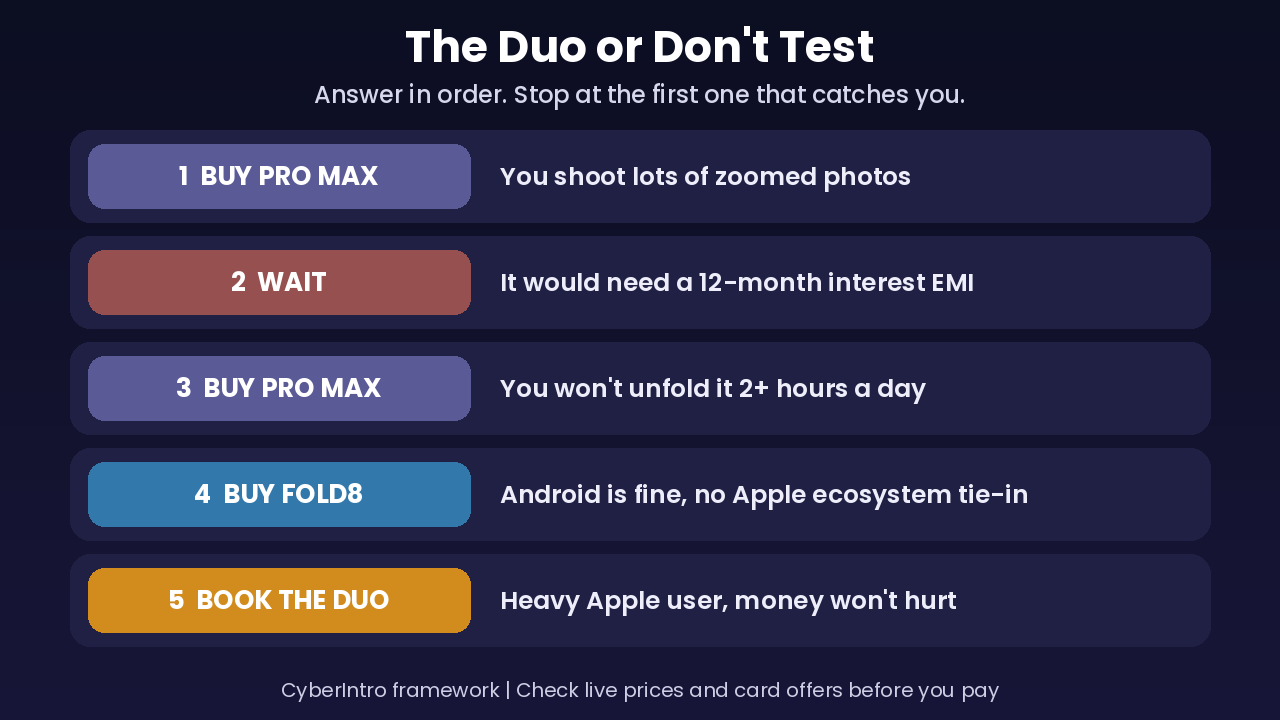
The Duo or Don’t Test
Answer these in order and stop at the first one that catches you. It takes about two minutes and could save you a lakh.
- Do you shoot a lot of zoomed photos, like stage events, wildlife or sports? If yes, the answer is BUY PRO MAX. The 8x telephoto is something the Duo simply does not have.
- Would the purchase need a 12-month interest EMI? If yes, the answer is WAIT. Paying around Rs 26,000 in interest on a first-generation product is the worst version of this deal.
- Will you actually use the big screen for two or more hours a day, for reading, spreadsheets, split-screen work or streaming? If no, the answer is BUY PRO MAX. A foldable you rarely unfold is just a thick, expensive phone.
- Are you happy on Android and not tied to a Mac, iPad or iCloud family setup? If yes, the answer is BUY FOLD8. You keep the foldable experience and roughly Rs 1.25 lakh.
- Still here? You are a heavy Apple user who wants one device to replace a phone and a small tablet, and the money will not hurt. The answer is BOOK THE DUO, but visit an Apple Store first and use it for ten minutes, opened and closed.
Should you buy on day one?
Here is our general rule for any first-generation product: early buyers pay the most and test the hardware for everyone else. That is not a prediction that anything is wrong with the Duo. It is just how new categories tend to go, and prices on later stock or next year’s model usually look kinder. If you pass the test above, buying now is fine. If you are on the fence, waiting a few weeks for real-world reviews on crease, hinge feel and battery costs you nothing.
Also budget for protection. A Rs 3 lakh foldable with a large inner screen is exactly the device where an extended care plan makes sense, so check the AppleCare+ price for the Duo at checkout and add it to your total before deciding. If you are hunting for a regular iPhone deal instead, our festive iPhone buying guide covers which models make sense this season, and our exchange vs sell guide helps you squeeze more out of your old phone.
Final Thought
The iPhone Duo is a seriously impressive piece of engineering, and for a heavy Apple user who wants a phone and a mini tablet in one pocket, it may be worth every paisa. For everyone else, the maths is blunt: Rs 1.2 lakh more than a Pro Max, a weaker zoom camera, eSIM only, and short no-cost EMI windows. Dil maange more, sure. But let the wallet vote too.